THE PROBLEM
Where the friction starts.
A sequence of one-off websites can produce many pages without producing a reliable method. Reference material, customer content, visual structure, and styling become tangled, and asking a model to make something “better” leaves the target difficult to inspect.
THE APPROACH
A system around the task.
Design OS separates page structure, content, and style through a shared intermediate representation. A component and pattern catalog, themes, composition and rendering packages, provenance, and review surfaces make the pieces available for reuse and evaluation.
- References + assets
- Typed design knowledge
- Compose + render
- Inspect + refine
WHAT WAS BUILT
The choices that make it work.
Represent the parts explicitly
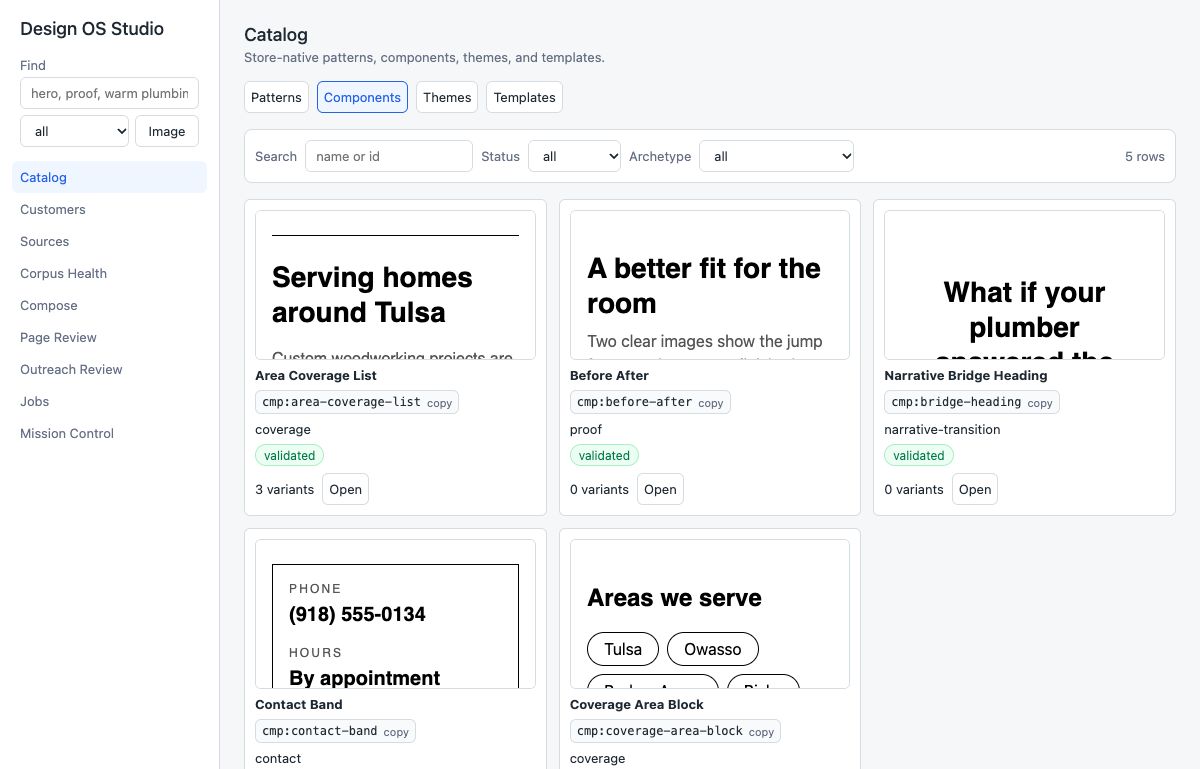
Typed page and component documents define slots, variants, roles, tokens, and relationships. A visual catalog exposes those parts instead of hiding the whole system in prompts.
Separate assembly from styling
Composition and themed renderers let the system change content or presentation without rebuilding every part. Deterministic jobs and review records support repeatable operations.
Treat quality as a research question
The later relational-precedent framework distinguishes fidelity, fitness, coherence, preference, effectiveness, and cost. A selected reference is evidence to investigate, rather than a blanket certification of quality.
CURRENT STATE
Working evidence. Clear boundaries.
The repository contains implemented packages and a compiled Studio interface alongside the architectural and research documents. The screenshot shows the original compiled Studio with a selected excerpt of existing component documents and their fixture renders.
The broader precedent-intelligence framework is an ongoing research direction. A working catalog and renderer do not establish automatic design quality or business effectiveness; human review still matters.
Source and capture notes
Implemented packages, compiled Studio, component exports and fixtures, operations documentation, relational-precedent draft, and history through 6ae44d2.
Reviewed November 23, 2026. Visuals are captured from source applications or their original renderers in isolated previews. Synthetic content is demonstration data, not a project outcome metric.